Cazorla's Farewell Signals the End of an Era for La Liga Itself
Cazorla Bids Emotional Farewell: A Legend Leaves a Legacy in La Liga
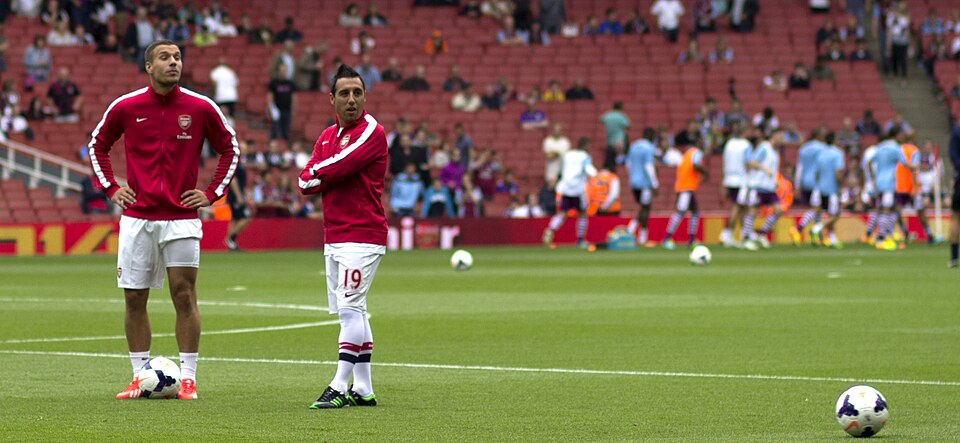
The possession-based, technically exquisite Spanish football that defined the 2000s and 2010s is now dead, replaced by something more fragmented, more mercenary, less beautiful.
The tears came naturally to Santiago Cazorla on Saturday afternoon, streaming down a face that has weathered nearly two decades of Spanish football’s most unforgiving demands. As Real Oviedo’s midfielder walked off the pitch in the Asturian twilight, embracing teammates and acknowledging a crowd that has watched him grow from prodigy to sage, the moment felt weightier than a single player’s retirement. It felt like La Liga itself was saying goodbye to something essential—a reminder of what happens when craft, intelligence, and an almost monk-like dedication to the game’s subtleties refuse to fade, even as bodies inevitably slow.
Cazorla’s departure matters not because Oviedo are title contenders—they emphatically are not—but precisely because his career trajectory illuminates the vast, often brutal stratification of modern La Liga. Here was a player who graced the midfields of Arsenal and Villarreal, who won trophies and played in Champions League knockouts, who represented Spain with honour, now finishing his career in the second tier’s emotional embrace. That is not tragedy. That is the honest reckoning every footballer must eventually face. Yet it also crystallises a fundamental truth about La Liga’s current landscape: the league has become increasingly bifurcated, with the elite clubs hoarding resources and silverware while the rest scramble for survival or modest European scraps.
The Real Madrid and Barcelona machinery—now joined by Atlético Madrid’s methodical excellence—has created a chasm that grows wider each season. Cazorla’s generation knew a different La Liga, one where Villarreal could genuinely threaten for titles, where Valencia’s midfield could dominate Europe, where a talented midfielder might reasonably expect to contest for trophies at multiple clubs within the league. Today’s landscape is different. The distribution of wealth, television rights, and sporting infrastructure has calcified in ways that make such mobility far rarer. Young talents either emerge into the elite three’s orbit or find their ceiling elsewhere—often abroad, or in the secondary tiers.
What Cazorla represents, then, is not just the end of an individual career but a commentary on La Liga’s current structure. His choice to see out his final seasons at Oviedo, a club fighting in the Segunda División, speaks to something the modern game often overlooks: the value of stability, of loyalty, of finishing where your story began or where it feels honest to conclude. Oviedo gave him a platform when few others would have pursued an aging midfielder with injury history. In return, he offered them his intelligence, his experience, his presence as a living link to Spanish football’s golden era. That transaction—unglamorous, unspectacular, utterly lacking in commercial appeal—represents a kind of football that La Liga’s top tier increasingly cannot afford to prioritise.
The emotional weight of Cazorla’s farewell also underscores a generational shift. The midfielders who defined La Liga in the 2010s—Xavi, Iniesta, Busquets, Cazorla himself—operated in a philosophical tradition that valued possession, positioning, and the almost mathematical precision of movement. They were the intellectual aristocrats of the pitch. The modern game, even at La Liga’s summit, has moved toward intensity, pressing, and vertical play. Cazorla’s brand of football—patient, geometrically aware, built on the premise that the ball is easier to run with than a human body—feels increasingly archaic at the sport’s highest levels. That his final act plays out in Oviedo, far from the spotlight, feels almost fitting. There is a dignity in that distance.
For La Liga itself, the question becomes what his departure symbolises about the league’s future. The Spanish top flight built its global reputation on technical excellence and the development of extraordinary midfielders. That tradition is not dead, but it is endangered. The pressure to compete with the Premier League’s financial firepower, the German Bundesliga’s intensity, and the Italian Serie A’s resurgence has pushed La Liga toward a more homogenised, less distinctly Spanish model of play. Cazorla’s generation was the last to truly embody La Liga’s classical identity at the highest level. His successors, talented as many are, operate in a different tactical and commercial universe.
The tears on Cazorla’s face were not just about personal mortality, then, though that is surely part of it. They were also, perhaps unconsciously, a recognition of an era’s close. La Liga will continue, will produce brilliant players and fierce competitions. But the league that nurtured Cazorla—that rewarded the intelligent midfielder, that valued possession as a philosophy rather than a tactic—is already a memory. Real Oviedo gave him a stage for his final chapter. In doing so, they offered La Liga a moment to reflect on what it once was, and to wonder what it might yet become if it dares to remember its own roots.
The farewell was emotional because it had to be. Cazorla earned that right through decades of excellence. But it was also symbolic, a quiet punctuation mark on a sentence La Liga has been writing for the better part of a decade. The question now is what comes next—and whether the league has the wisdom to learn from what it is losing.
El Hincha